HH902

The best indoor cycle for a small space should do more than occupy less floor area. A genuinely practical compact fitness bike needs to remain stable during training, offer suitable resistance, fit the rider correctly, and be easy to store when the workout is finished. For apartments, bedrooms, home offices, and multipurpose fitness areas, the storage footprint can be just as important as the riding footprint.
This is why choosing a compact home fitness bike requires more than comparing dimensions. A smaller frame is not automatically better if it reduces riding comfort or makes the bike feel unstable. The most useful design is one that balances space efficiency, adjustability, workout quality, and everyday convenience.
A compact exercise bike has to solve two different space problems. First, it needs enough room for safe and comfortable riding. Second, it needs a practical place to go after the workout.
Many buyers only check the assembled dimensions, but this does not tell the whole story. Handlebar width, stabilizer bars, rider movement, access around furniture, and the space required to mount and dismount all affect whether a bike actually works in a small room.
For users comparing different home fitness solutions, an indoor cycle with adjustable resistance, seating, and a stable frame can provide a more practical long-term solution than simply choosing the lightest or narrowest model available.
| Factor | Why It Matters in Small Spaces | What to Check |
|---|---|---|
| Operating Footprint | Determines whether the bike fits while being used | Full length, width, and rider clearance |
| Storage Footprint | Determines whether the room can return to normal use | Folded size and storage orientation |
| Frame Stability | Supports safe riding despite a compact design | Base structure and frame rigidity |
| Adjustability | Allows different users to achieve a suitable riding position | Seat, handlebar, and resistance adjustment |
| Noise Level | Important for apartments and shared homes | Drive system and mechanical operation |
| Mobility | Makes frequent storage easier | Bike weight, handles, and transport design |
For many apartment users, a foldable design provides a clear advantage because the exercise area does not need to become a permanent home gym. After training, the bike can be folded and moved beside furniture, into a storage area, or against a wall.
However, foldability should not come at the expense of stability. A good folding mechanism needs to lock securely in the riding position and remain easy enough to operate that users are willing to fold the bike regularly.
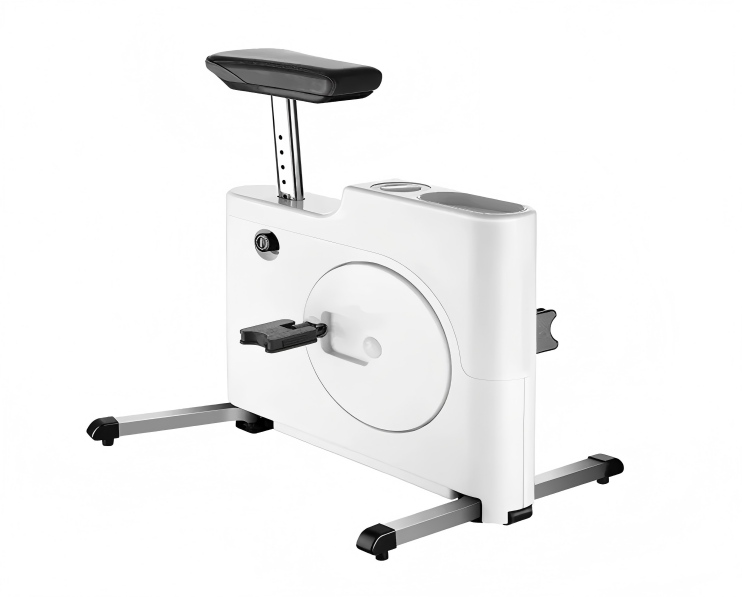
The Hohitec HH902 is a useful example of this type of space-saving design. According to Hohitec, the bike can reach approximately 10 cm in thickness when folded, which is specifically intended to make storage easier in compact environments.
This makes a foldable indoor cycle particularly relevant for users who exercise in bedrooms, apartments, offices, or other rooms that need to serve several purposes throughout the day.
The safest way to plan a small home workout area is to think beyond the dimensions listed on a product page.
The rider needs enough space to approach the bike, mount comfortably, adjust the seat, move the handlebars if required, and step away safely after training. A bike that technically fits between two pieces of furniture may still feel inconvenient if the rider has to move a desk or chair every time it is used.
Before buying, mark the expected footprint on the floor using removable tape. Then simulate how you would get on and off the bike. This simple test often reveals practical problems that are difficult to recognize from measurements alone.
Door swing, drawers, cabinets, power outlets, and walking routes should also be considered. In small homes, equipment that interrupts everyday movement quickly becomes frustrating, no matter how good its training performance may be.
Compact dimensions attract attention, but several functional features matter more after the first few workouts.
A smaller footprint should not make the bike feel unstable. The frame should remain secure during steady-state cycling as well as higher-effort sessions. Users should pay attention to base design, structural rigidity, and how well the bike remains planted on the floor.
A compact bike still needs to fit the rider. Seat height, handlebar position, and pedal placement influence comfort and riding efficiency. If adjustment is too limited, the user may adopt an awkward posture simply to fit the machine.
Resistance should provide enough progression for the intended training style. Beginners may prioritize smooth adjustment, while more experienced users may want a wider range for interval training or higher-intensity sessions.
Storage should be part of the design rather than an afterthought. A foldable bike is most useful when one person can fold, move, and reopen it without complicated disassembly.
Yes. Indoor cycling can support cardiovascular training, lower-body endurance, interval workouts, and regular physical activity without requiring a large exercise area.
This is one reason cycling equipment is particularly suitable for smaller home gyms. The user remains in one defined location throughout the workout, unlike exercise formats that require longer movement paths or several pieces of equipment.
The broader indoor cycling benefits also help explain why compact bikes appeal to home users who want a repeatable cardio routine without travelling to a gym. Your keyword ranking sheet shows this exact phrase with search volume and a corresponding Hohitec information page.
Consistency, however, depends heavily on convenience. A bike that takes fifteen minutes to set up is much less likely to be used regularly than one that can transition quickly between storage and training.
The decision should be based on how the room is used rather than assuming one design is always superior.
| Situation | Foldable Bike | Conventional Stationary Bike |
|---|---|---|
| Small Apartment | Highly practical | May occupy too much permanent space |
| Dedicated Home Gym | Useful but not essential | Often suitable |
| Bedroom or Office | Strong advantage | Less flexible |
| Frequent Storage | Designed for this purpose | Usually less convenient |
| Maximum Structural Rigidity | Depends heavily on design quality | Often easier to achieve |
A dedicated home gym gives users more freedom to prioritize maximum rigidity and larger equipment. In a living room or bedroom, storage convenience usually becomes much more important.
Noise is one of the most overlooked buying factors for small-space fitness equipment.
In an apartment, mechanical vibration and repetitive noise can be more noticeable because the bike may be positioned close to bedrooms, neighbors, workspaces, or shared living areas. A smooth drive system is therefore valuable, especially for users who train early in the morning or late at night.
Floor contact also matters. A suitable exercise mat may improve stability, protect flooring, and reduce some transmitted vibration, depending on the bike and room construction.
For retailers and distributors, noise performance can also influence customer satisfaction. Compact home fitness products are frequently purchased specifically because they will be used in domestic environments, so quiet operation can be a meaningful product-selection criterion rather than a minor specification.
For B2B buyers, a compact bike needs to work not only for the end user but also throughout the supply chain.
Folded dimensions can affect packaging, warehousing, transportation, and retail display efficiency. A product that occupies less volume may be easier to handle in distribution channels serving urban home-fitness customers.
Retailers should also evaluate adjustment range, frame stability, assembly complexity, user instructions, optional colors, customization capability, and after-sales support. Hohitec specifically positions its indoor cycle range for home users as well as gyms, fitness centers, distributors, and bulk-order customers, while highlighting compact design and OEM/ODM flexibility.
Clear communication is equally important. Product pages should show both operating and folded dimensions rather than describing a bike simply as “compact.” Demonstrating the actual folding process can reduce uncertainty for buyers who are primarily concerned about storage.
Yes, particularly when the workout room also functions as a bedroom, living room, or office. Their value comes from allowing the training area to return to normal use after exercise.
Yes. Training quality depends more on resistance, rider fit, workout structure, stability, and consistency than on the physical size of the bike.
Measure the full riding area, available storage space, access route, nearby furniture, and any restrictions caused by doors, cabinets, or other fixtures.
Not necessarily. Stability depends on frame engineering, base design, locking mechanisms, and build quality. A well-designed folding bike should remain secure during normal operation.
There is no single feature, but the combination of stable operation, easy storage, suitable rider adjustment, and practical resistance control is more important than achieving the smallest possible dimensions.
Choosing the best indoor cycle for a small space requires balancing compactness with actual workout performance. A bike should fit the room without forcing the user to compromise on stability, adjustment, resistance, or everyday convenience.
For apartments and multipurpose home gyms, foldable designs can offer a particularly practical solution because they reduce the permanent footprint of fitness equipment. The best choice is ultimately the bike that is comfortable enough to use regularly and simple enough to store when the workout is finished.