HH902

As aging populations continue to grow worldwide, senior care providers, rehabilitation centers, and mobility aid distributors are facing increasing demand for smarter elderly safety solutions.
Traditional walking canes still play an important role in mobility support. However, many healthcare buyers and assisted living providers are now looking for products that do more than improve balance alone. Falls, delayed emergency response, and wandering incidents remain major concerns in modern elderly care.
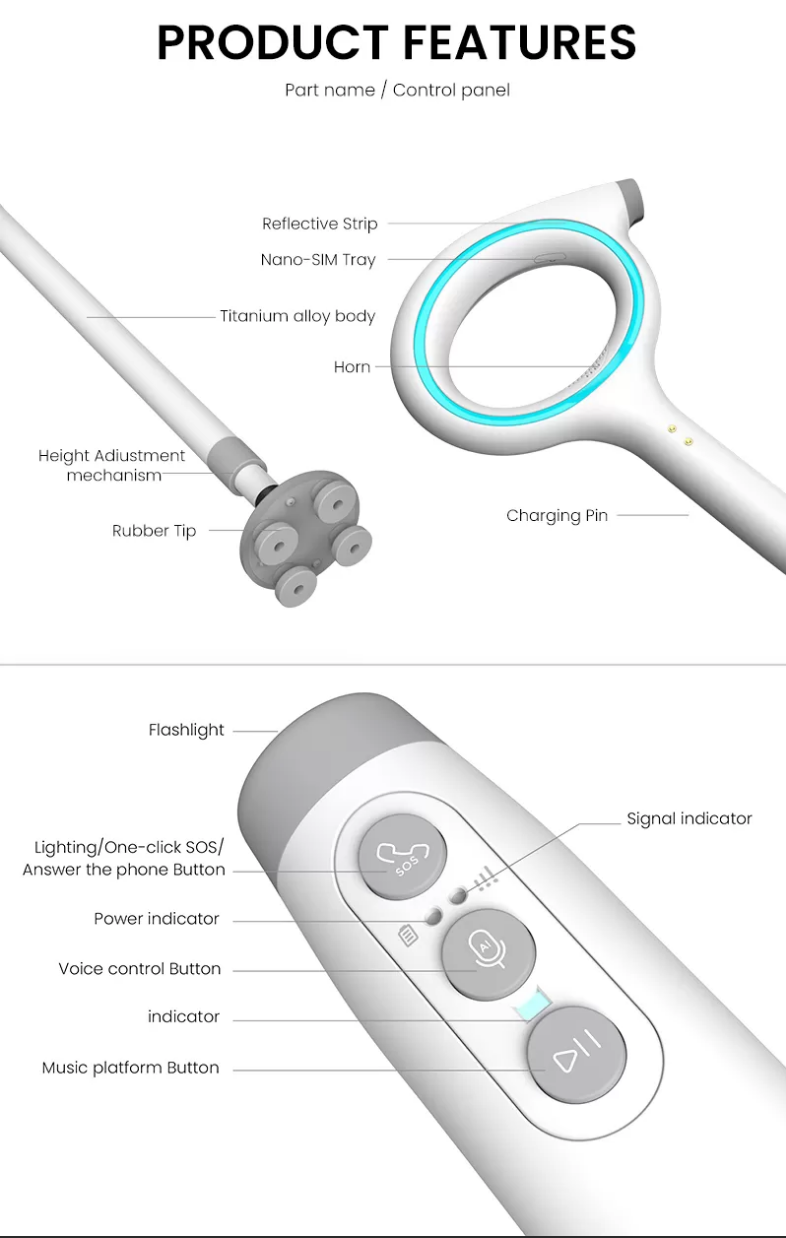
This is why smart mobility devices are becoming a fast-growing category within assistive devices for the elderly. Products such as the HoHiTEC HH8816 GPS walking cane combine walking assistance with fall detection, location tracking, SOS communication, and nighttime safety features in a single device.
This article compares traditional canes and smart canes side by side to help distributors, senior care buyers, and healthcare equipment providers understand which solution best fits modern elderly care needs.
A traditional cane helps improve balance and mobility, but it does not address what happens during an emergency.
For seniors living independently, especially those with fall history or mild cognitive decline, mobility support alone may not be sufficient. Care facilities and family caregivers increasingly need solutions that can also support:
1.Emergency response
2.Real-time location tracking
3.Fall monitoring
4.Safer nighttime movement
5.Remote caregiver communication
This shift is one reason why smart mobility aids for seniors are becoming more common in rehabilitation centers, assisted living facilities, and connected healthcare environments. The difference is no longer simply about “walking support.” It is about combining mobility assistance with proactive elderly safety management.
The table below compares a standard walking cane with a modern GPS walking cane such as the HoHiTEC HH8816.
| Feature / Capability | Traditional Cane | Smart Cane (e.g., HoHiTEC HH8816) | Best For |
| Walking support | Basic mobility assistance | Ergonomic support with anti-slip stability | Daily elderly mobility support |
| Fall detection | Not available | Automatic fall detection and caregiver alerts | Seniors at risk of falls |
| GPS location tracking | Not available | Real-time GPS monitoring through mobile app | Seniors who walk independently |
| Emergency SOS communication | Not available | One-touch SOS emergency assistance | Faster emergency response |
| Nighttime safety lighting | Not available | Built-in LED lighting | Low-light environments |
| Voice-assisted control | Not available | Hands-free voice interaction | Seniors with limited hand mobility |
| Integrated safety functionality | Walking support only | Combined mobility and safety monitoring | Modern elderly care programs |
| Caregiver monitoring support | Limited | Real-time communication and tracking | Assisted living and home care |
As the comparison shows, a smart cane is not simply an upgraded walking stick. It is a connected elderly mobility device designed for both mobility assistance and safety management.
One of the biggest limitations of a traditional cane is that it cannot respond after an accident occurs.
A smart cane with automatic fall detection can notify caregivers or emergency contacts immediately if the user falls and becomes unable to communicate. For seniors living alone, reducing emergency response time can significantly improve safety outcomes.
This is why elderly fall prevention devices with real-time alert systems are receiving growing attention from care providers and distributors.
Families and care facilities are increasingly concerned about wandering risks among seniors with memory-related conditions.
A GPS walking cane allows caregivers to view the user’s location in real time through a connected application. This feature is particularly valuable for:
1.Assisted living environments
2.Memory care programs
3.Independent senior communities
4.Home healthcare services
Compared with passive identification tools, real-time GPS tracking provides a more proactive safety solution.
The HoHiTEC HH8816 features an anti-slip base designed to improve grip on wet sidewalks, uneven terrain, and indoor flooring.
For elderly users, confidence while walking is often just as important as physical support. Better stability can encourage seniors to remain active and socially engaged rather than limiting movement due to fear of falling.
Many falls happen during nighttime movement inside the home or care facility. Integrated LED lighting helps illuminate walking paths, stairs, and bathroom routes without requiring seniors to carry additional lighting devices.
This small feature can play an important role in improving nighttime mobility safety.
Traditional emergency buttons can be difficult for seniors with arthritis or limited hand strength. Voice-assisted controls and one-touch SOS features simplify emergency communication and improve usability for older adults who may struggle with small controls during stressful situations.
A smart cane may provide the greatest value in the following environments:
1.Assisted living facilities
2.Independent senior living communities
3.Rehabilitation and recovery centers
4.Home healthcare programs
5.Elderly care programs focused on fall prevention
6.Memory care environments
7.Senior mobility product distribution networks
For seniors who still value independence and mobility, connected walking aids can help balance safety with freedom of movement.
1.Seniors with stable balance and low fall risk
2.Temporary mobility recovery situations
3.Environments with constant caregiver supervision
4.Basic mobility assistance programs
1.Seniors living independently
2.Users with previous fall incidents
3.Elderly individuals with wandering risk
4.Connected healthcare environments
5.Senior care providers focused on proactive monitoring
6.DME distributors expanding smart elderly care product categories
7.Importers and wholesalers seeking differentiated mobility products
As connected healthcare technology continues to evolve, smart mobility aids are becoming an increasingly important category within assistive technology for seniors.
The elderly care industry is shifting toward connected safety solutions that combine monitoring, communication, and mobility support in one device.
For distributors and OEM buyers, smart canes offer several advantages:
1.Higher-value product positioning
2.Product differentiation in competitive mobility markets
3.Growing demand for connected elderly care devices
4.Simplified device management compared with multiple separate products
5.Opportunities for OEM and customized elderly care solutions
Manufacturers such as HoHiTEC are helping drive this shift by developing GPS walking cane products designed for modern elderly care environments.
Traditional canes continue to provide important mobility support, but modern elderly care increasingly requires more advanced safety features. Smart canes with GPS tracking, fall detection, SOS communication, and nighttime lighting offer a more complete solution for independent senior living and connected care environments. For distributors, senior care providers, and healthcare equipment buyers, products like the HoHiTEC GPS walking cane represent a growing category within smart elderly mobility solutions.
When evaluating elderly mobility products, buyers should consider more than walking support alone. The most effective mobility aids are those that improve both independence and safety.
As senior care continues moving toward connected monitoring and proactive fall prevention, smart canes are becoming more than mobility devices—they are part of the broader future of elderly care technology.